
After a few Belgian beers at The Cheeky Monk, my friend Chad and I began to talk about economics.
As we discussed the source and nature of money, we began to zero in on the idea of value. What is value? How is it created? Where does it come from?
Initially, I argued that value is created by humans: a combination of physical labor and intellectual capital. But it turns out, my definition was incomplete.
And, as Chad and I argued our individual points of view, I quickly discovered that defining value is actually a bit harder than I initially expected.
How True Value Is Created
Raw materials — like wood, metal, and even human labor — are created by God. God has given us time, natural resources, bodies, and brains, which we can then translate into all sorts of services and products.
As Deuteronomy 8:18 says, “But you shall remember the LORD your God, for it is He who is giving you power to make wealth.”
But does the act of creating something automatically create value? Not necessarily.
If I create a product that nobody wants and is never used, I have not created true value, rather only latent value. And if that latent value is never realized, then my investment of time and effort has been a waste.
For true value to be created, there has to be demand on the other side of the equation. At the moment when latent value meets demand, true value is created.
Of course, there is an additional ingredient in this equation. Because how else can latent value and demand connect except through advertising?
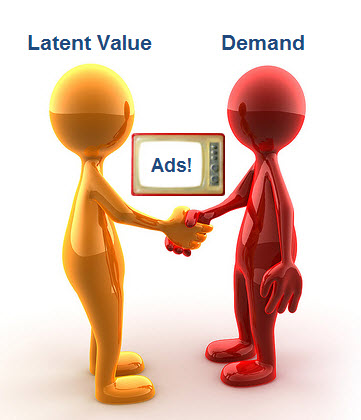
Anybody can create true value by:
- Identifying demand.
- Using their God-given abilities to meet the demand with a product or service.
- Advertising the product or service they’ve created.
What Appears as Value Is Not Always True Value
Any discussion of value wouldn’t be complete without at least touching on the broader societal implications.
For instance, a man may demand a gun to murder somebody with, and another man may manufacture that gun. When the exchange is made, value has only been created on a purely economic level.
The use of the gun to murder does not create value at all, and in fact harms society as whole.
Ultimately, true value can only be realized when the products and services being exchanged are moral in nature and are used in compliance with the law. Otherwise, there is only an illusion of value.
These are my thoughts on the nature and creation of value. If you have anything to add, feel free to leave a comment below.
-Ryan M. Healy
Similar Posts:
- Your #1 Asset
- Three Business Models Explained
- The Dark Side of Advance Selling
- Copywriters: Guilty as Charged?
- The Laziness Alibi: Legit Defense or a Clever Cover-Up for Fraud?
John Wanamaker once said, "Half the money I spend on advertising is wasted; the trouble is I don't know which half." But thanks to technology, it's now easy to know which half of your advertising is working... and which half isn't. That's because LinkTrackr reveals the profitablity of ALL your advertising. Start Tracking Now! » |


{ 6 comments }
Note sure if this applies to exactly what you are saying, but it's interesting nonetheless…
FROM: http://blog.mises.org/2622/a-tick-a-tooth-subje…
…The following mutually beneficial exchange takes place in Tom Sawyer, and the author concludes with a nugget of wisdom that seems to have been lost on intellectuals for a century or so:
“Say — what’s that?†[Tom asks Huckleberry Finn]
“Nothing but a tick.†“Where’d you get him?â€
“Out in the woods.â€
“What’ll you take for him?â€
“I don’t know. I don’t want to sell him.â€
“All right. It’s a mighty small tick, anyway.â€
“Oh, anybody can run a tick down that don’t belong to them. I’m satisfied with it. It’s a good enough tick for me.â€
“Sho, there’s ticks a plenty. I could have a thousand of ‘em if I wanted to.â€
“Well, why don’t you? Becuz you know mighty well you can’t. This is a pretty early tick, I reckon. It’s the first one I’ve seen this year.â€
“Say, Huck — I’ll give you my tooth for him.â€
“Less see it.â€
Tom got out a bit of paper and carefully unrolled it. Huckleberry viewed it wistfully. The temptation was very strong. At last he said:
“Is it genuwyne?â€
Tom lifted his lip and showed the vacancy.
“Well, all right,†said Huckleberry, “it’s a trade.â€
Tom enclosed the tick in the percussion-cap box that had lately been the pinchbug’s prison, and the boys separated, each feeling wealthier than before.
In Peter Drucker's book on management he says the customer defines the product (value).
Former president of SAS put in place a quality program called the 1000 points of contact. Every time the company had a contact with the customer was an opportunity to provide value (or lose it!).
A lot of internet marketers (and others) may have a valuable product but then hide behind their support desk if the customer needs anything.
I had a portable hedge trimmer from Toro. The battery charger went dead. Try as I might, I could not get a replacement. Will not by anything from Toro again.
John Deck
Ryan,
I heard Roy Williams describe value (used as an adjective) as the relationship between what the customer feels something is worth and what they pay (i.e. “That is a good value” or “bad value.”). Whether something is a good value or a poor or bad value is completely in the mind of the purchaser.
And I think this is where your point about advertising fits. Good advertising (or selling) helps the customer to change their viewpoint about something so that it is perceived (i.e. becomes) as a good value and worth the money asked for.
And I think that is really the point of the post of Perry Marshall's that you link to: those in humanitarian work / worthwhile non-profit work assume (often because they can see it) that anyone who reads their brochure realizes the value of what they do. The problem is, unless that value is described to them, the reader of that brochure as no way to understand the relationship between the money they give and the value provided by the humanitarian organization.
Funny, a lot of businesses seem to have the same problem….
Great post, Ryan.
- John
Ludwig von Mises suggested that value was subjective in economy… Rand said that values were objective… but she defined value as that what man seeks to gain or keep.
Pretty simple.
From my own experience in business, the phrase “value is when both sides feel they got the best of the transaction,” sums it up. If I work for 1 hour to earn $10, I valued my time less than or equal to the money I received. The employer sees it the opposite way. When I buy something, I value what I buy, more highly than what I paid. Regardless of what the seller paid for it, or it cost to create, we each feel we have received full value.
Advertising, and Marketing are processes for finding those who need/want the product or service, and telling them about it. This is a necessary part of the equation because rarely are the two in close physical proximity. Granted, with the Internet the world is at our door, but it's a pretty big doorstep. :-)
We need a guide of some sort to help us find what we need/want. That guide, if done properly, helps us decide if the value is there, before we consider buying. Once we have decided that the value is probably there, and we make the decision to consider buying, we are ready to be “sold.”
Reminded me a bit on Paul Graham on how to create wealth….
http://www.paulgraham.com/wealth.html
Comments on this entry are closed.