
Many of the potential clients who will contact you will try to get you to negotiate your fees down.
They’ll say things like, “We’re looking for a long-term relationship. We’ve got a lot of work. We could keep you busy for a long time.”
The implication, of course, is that you should lower your fee based on the potential for future work. (Don’t do it. The future work rarely materializes.)
By the way, have you ever had a potential client say, “We’re looking for a short-term relationship. A one-project stand, if you will. After that, we’ll both go our separate ways as if we never knew each other.”
Short-term business relationships often imply something didn’t work out. So why are potential clients so eager to assert their desire for a long-term relationship? Answer: Because they want you to lower your fee!
Anyway, another negotiation technique clients like to use is minimization. They’ll attempt to minimize the importance of your work and the effort required to complete it.
For example, after agreeing that a potential client needs a 2-page direct mail letter, he might say, “So we really just need a simple 2-page letter. That shouldn’t take long for you to do, right? Maybe an hour?”
I quote fees based on the project. I don’t base my quotes on time required, but rather on the value I believe I can create for the client.
But some potential clients are price-shopping. They want to pay as little as possible. That’s why they try to get you to quote a fee based on the time it might take you to do the work.
Here’s the thing:
I’m a fast writer today because I’ve been writing regularly and hitting deadlines for 18 years. My client is not paying for one or two or ten hours of work. My client is paying for all the years I’ve invested in learning how to write and sell in print.
I recently re-read the book Rework by Jason Fried and David Heinemeier Hansson. On page 266 I made note of this observation:
Easy is a word that’s used to describe other people’s jobs. “That should be easy for you to do, right?” But notice how rarely people describe their own tasks as easy. For you, it’s “let me look into it” — but for others, it’s “Get it done.”
There’s an old story about Picasso sketching a portrait for a lady and then asking for 5,000 francs. “But it only took you a minute!” the woman says. “No, it took me my entire life,” Picasso replies.
I could not find any evidence that this story actually took place. I assume it’s an urban legend.
But I did find an interesting story about Paula Scher, the woman who designed the famous Citi umbrella logo. She went into her first client meeting with Citi Group and sketched the design on a napkin before the meeting was over.
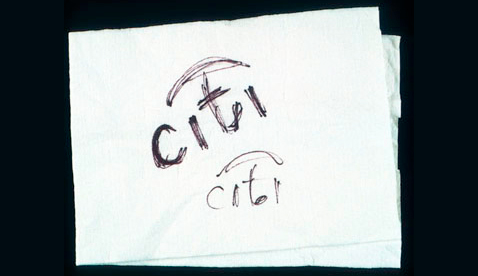
As she recounted this experience in a video interview, she said:
How can it be that you talk to someone and it’s done in a second? But it is done in a second. It’s done in a second and in 34 years, and every experience and every movie and every thing of my life that’s in my head.
If you’re interested, you can watch the entire 7-minute video here:
Never forget: What you do is not “easy.” It’s valuable. And it’s taken you a lifetime to get where you are today. Don’t sell yourself short.
-Ryan M. Healy
I launched my freelance copywriting career on June 13, 2005. Much to my surprise, I landed three clients in the first two weeks. If you'd like to discover how I did it, then click here now » |


{ 26 comments }
Hi Ryan,
I’ve been thinking about the Picasso quote for a while now. I think there’s a caveat…
Imagine that instead of Picasso it’s an unknown and mediocre artist.
If he says the “5,000 francs” and “it took me all my life” line it doesn’t work. In fact he’s likely to end up with a black eye.
Picasso can get away with it because he’s brilliant. No one else could have sketched the portrait the way he did.
So my learning is, if you want to be able to charge like Picasso, you’ve got to be as good as him (or at least a damn site better and different to your competitors).
Ian
Good point, Ian. You’ve got to build a reputation before you can demand higher fees.
i like that quote: “it’s done in a second AND 34 years”…took a minute to understand it, but yah, 34 years + 1 second haha. nice!
jim
Yeah, I love that quote. It’s very insightful.
Like the saying:
“An overnight success…
..10 years in the making.”
Exactly.
Thanks Ryan
I am meeting with a potential client with that type of thinking today… so very fortuitous to read your comments. Sometimes, we try so hard to please the client that we forget to please ourselves.
Cheers
Warren
Hope your meeting goes well, Warren. :-)
That’s a very valid point you made about how long it really takes someone produce great copy.
Thanks for sharing.
You’re welcome, Mustafa.
I agree completely Ryan. When a prospective client tells me they have future work for me, I say, “But of course, you can’t guarantee that, can you? Anything can happen between now and then. Since neither one of us can guarantee what happens tomorrow, let’s take one step at a time.”
If they don’t have a reasonable response, I would up the ante and say something like “My fees are based on you getting a dramatic return on your investment and me being paid in line with the value I provide. It’s up to you to decide whether you want to go forward or not.”
That’s a great response, Alan. Thanks for sharing it.
Ryan, it’s funny — I actually have had a client say he just wanted a “one-project stand”.
I usually aim for long-term partnerships with my clients. This guy was like, “No, I don’t want that.”
But he appreciated the value of my work, so it was okay ;)
Haha! That’s funny. Never had that happen before, but I guess it could…
Ryan why do you keep provoking me to post?
The dilemma is the market makes the price.
How much is invested in time, money or talent really doesn’t matter.
What matters is bridging the gap between commodity and bespoke.
The emotional satisfaction gap you so masterfully bridge.
How about changing a want to a need?
Hey Mike – Thanks for responding to the provocation. :-)
You make some great observations. Yes, the market makes the price. The trick is differentiating enough to get to the high end of the market.
I can’t tell you how many times that happens. I’ve had a few clients where the “long term work” really did materialize into years of work, but it’s the exception rather than the norm.
Like Alan said, unless they can guarantee (by paying in advance) the future work, it means absolutely nothing to me.
I expect future work anyway. I also expect referrals, and tell the client that before we even start the project. So a client saying either of those isn’t going to get me to lower prices :)
Jeremy Reeves
Hi Jeremy – Like you, I’ve had some of that “long term work” materialize. But in those cases, the client did not use it as a negotiating tactic. They hired me at my rate, enjoyed working with me, and continued hiring me for years.
I think Alan’s suggestion is really good.
Great post!
I really think there is another side to this… That side being that we also need to be selective as to the type of clients we entertain because we know that our unique selling proposition is based in quality rather than price or even convenience.
There has to be a fine line drawn between explaining how one will obviously benefit from our services versus justifying why we charge what we charge. Huge difference.
Just out of curiosity, Ryan, have you ever told any of your prospective clients that they only begin to see price breaks after they have already done a certain amount of business with you? This is somewhat off topic, but contextually related… My hairstylist that I have been going to for SEVENTEEN years didn’t start giving me price break until after two years of seeing her every two weeks. When I asked her why her prices changed and she said because I had already proven that we would have a long term relationship. I had proven it through my past actions, not in a promise of my future actions.
Great story about your hair stylist.
And, yes, I often offer price breaks to good clients who’ve hired me for multiple projects.
There are usually economies of scale anyway because I become so familiar with their business and products.
Funny, my wife was telling me today that everything that I’ve gone through and done has prepared me for what I’m doing next.
Thanks for the reminder.
John
You’re welcome, John. Hope you’re doing well. :-)
Jim Rohn said it in a slightly different way:
‘ You don’t get paid for the hour, you get paid for the value you bring to the hour’.
I have just doubled my prices. And interestingly, doubled the interest in my services. I still think I’m on the cheap side. But I know the time involved in providing that service is immaterial: I add an awful lot of value with the work I provide and that’s what they pay for. The years I spent studying the subject. The years of experience. The years of successes and mistakes and the lessons I learned from both.
I even announced it in a blog post: http://www.kanzimarketing.com/2012/03/20/up-up-up/
I offered discounts and special offers on my cheap prices when I started the business in January, but no more. I will give regular clients a good price for the value I give, and I will give new clients a good price for the value I give. If they don’t realise the value that I offer, they can find a cheaper consultant.
I know my value. If you know you provide a better service or product than your competitors, then I don’t think you have to discount – in fact you should follow my example and increase your prices :-)
Angie – Good for you for doubling your prices!
And thanks for commenting. I appreciate it.
Hey Ryan,
I like the part ( you know your point not the idea) about how clients diminish the work it takes you to do something for them, such as SEO work,or copy-writing. I remember a story I heard Brian Tracey say at a seminar I went to when I use to sell insurance years ago, it went basically like this: a guy goes into his dentist due to a tooth that was hurting, the patient complains about the cost of the diagnosis, $400 for a tooth extraction. The patient asks how long does it take you to do that? The dentist replies, 5 minutes. The patient says for 5 minutes of work!?? The dentist replies, well I can take an hour to do it if you really want! So, its not the time it takes its the value of the result that the client is after and that comes from experience and maybe a little luck :-)…
I hadn’t heard the story about the dentist. That’s pretty funny — and poignant. Thanks for sharing it, Bart.
Comments on this entry are closed.
{ 1 trackback }